
Showing posts with label sci-fi. Show all posts
Showing posts with label sci-fi. Show all posts
Monday, December 30, 2013


Friday, November 8, 2013
Frankenstein's Army (2013) Review
   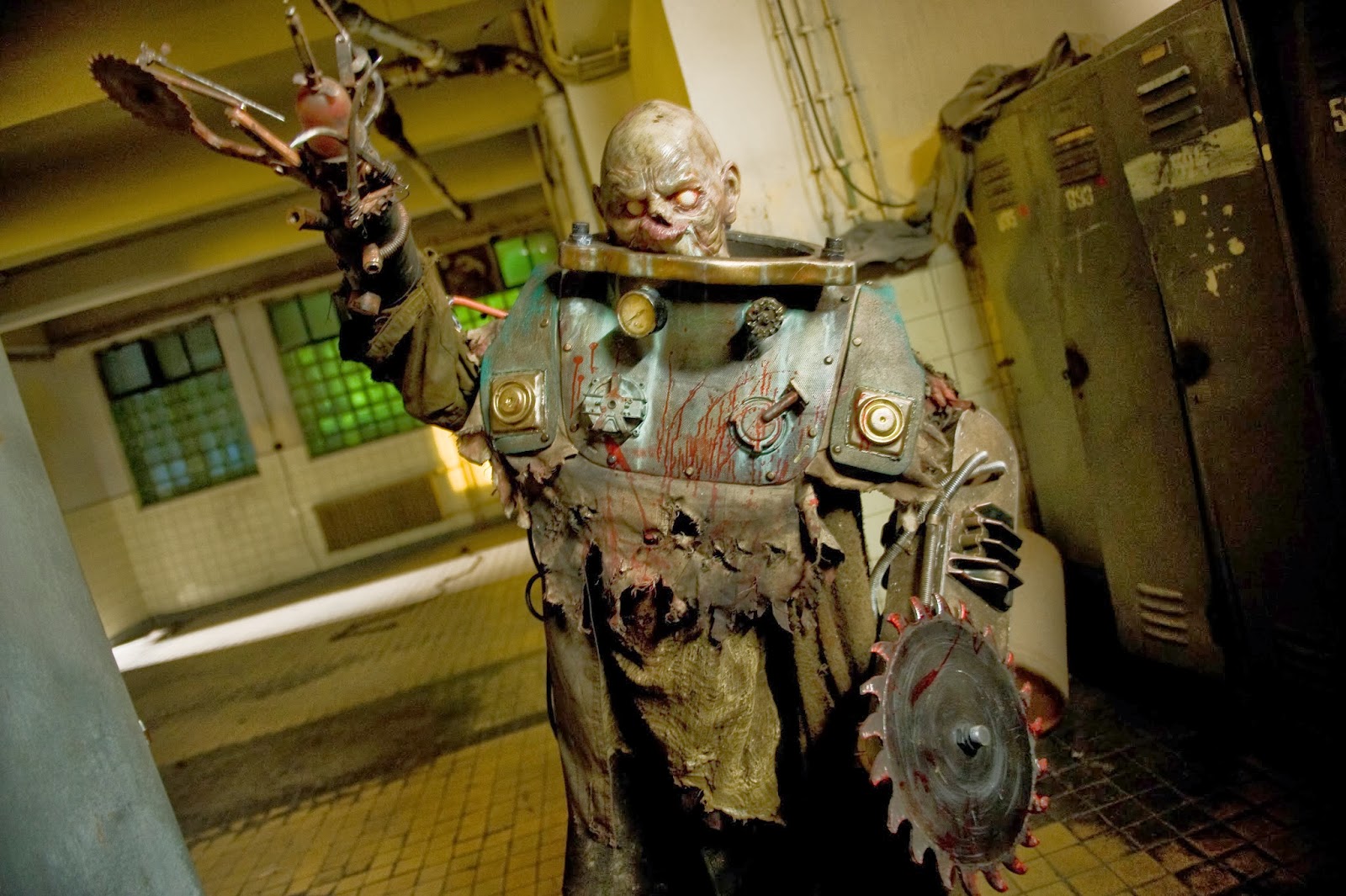
Pros:
+Awesome monster design
+Good special effects
Cons:
-Poor writing
-Underwhelming execution
Similar films: Dead Snow
|
Director: Richard Raaphorst
Stars: Karel Roden, Joshua Sasse
Genre: Science Fiction, Horror, War
The rough concept of Frankenstein's Army is that essentially it's the Frankenstein story set in WWII instead of the 19th century. Keep in mind it's a very loose Frankenstein story; that is, it really only shares a few basic themes, i.e. a scientist who assembles monsters. But I like the concept of a group of Russian soldiers going on a mysterious mission and having to fight off weird Nazi creatures while descending into a hellish laboratory. Horror movie + War movie? Awesome. I just wish the execution of this concept was a bit better. The writing isn't all that great. The writers felt the need to add some internal conflict within the group of Russian soldiers, which was honestly unnecessary. If it had been done well maybe I'd think differently, but it's not. The dramatic parts (and luckily there's not many of them) are pretty pointless and cliched. The characters are also pretty dull and almost all their action/reactions are completely unbelievable. It doesn't help that the acting is only ever decent at best. It's shot from a loose found footage first person perspective. I say loose because it's not very strict about it. There's plenty of cuts and stuff that defy the form. And while the shooting style does have a slight narrative purpose, it's really just there so that no actual quality cinematography had to be done. Which, ya know, for a low-budget horror movie it's understandable. It's not that scary either. Usually POV found footage films don't take much effort to be made scary, but this one is relatively action orientated. It basically plays out like an on-rails shooter. This could have easily been a spin-off of the House of the Dead video game series. Seriously; there's the first-person perspective, there's a a variety of monsters that just pop out randomly from behind doors, the monsters often just stand in front of the camera and attack the air, and much of the camera movement is nearly identical to something you'd see in an on-rails shooter (quick turn arounds, looking left and right around a room, peaking around corners, etc.). Monsters come out and the soldiers shoot at them for awhile while we observe from a soldier's point-of-view and then the monsters die and the soldiers continue on through some more corridors. This is a video game. Actually, I think this film would be more enjoyable if you get a light-gun (preferably a NES Zapper) and pretend to shoot at the monsters while you watch the movie. I think it'll actually work out pretty well and you may even trick yourself into thinking you're playing a video game. The best thing about this movie is easily the monsters. The creature design is pretty awesome (Mosquito Man!) and the special effects are done very well, even if they do sometimes look silly or unbelievable. They're over-the-top (monsters like these would be completely ineffective in actual warfare) but they look great. The main problem is that they don't really do much. The monsters pop out and dance around a while for the camera and then just die. If this movie is essentially a non-interactive on-rails shooter, then it's severely lacking a cool boss battle. Watch for the interesting monster design. That's about all that's worthwhile here. It's not bad, it's certainly watchable and mostly enjoyable, it's just nothing really special or impressive.  |
Friday, October 11, 2013
Creature with the Atom Brain (1955) Review
      
Purchase from Amazon: DVD
Other films by Edward L. Cahn: Zombies of Mora Tau, Invasion of the Saucer Men, It! The Terror from Beyond Space, Invisible Invaders
Similar films: Night of the Living Dead
|
Director: Edward L. Cahn
Stars: Richard Denning, Angela Stevens, Tristram Coffin
Genre: Science Fiction, Zombie
An American gangster teams up with a German scientist to get revenge on his enemies by controlling corpses reanimated with atomic energy.
The monster movies of the 30s used electricity, the ones of the 50s used atomic energy. Both themes were certainly products of their times. The story of Creature with the Atom Brain was written by legendary sci-fi/horror screenwriter Curt Siodmak. You've almost certainly watched one of his stories; he's written some real classics: The Invisible Man Returns, Invisible Agent, Black Friday, The Ape, The Wolf Man, Frankenstein Meets the Wolf Man, I Walked With a Zombie, Son of Dracula, House of Frankenstein, The Beast With Five Fingers, Bride of the Gorilla, The Magnetic Monster, Riders to the Stars, and the list goes on. He's certainly left a large impact on the world of sci-fi and horror films, and largely carried the genres through the 1940s.
Creature with the Atom Brain is one of Siodmak's lesser-known scripts, and it's definitely not his best work, but it remains enjoyable nonetheless.
The story involves remote controlled reanimated corpses doing the evil bidding of a gangster. This film is a fine example of a pre-Romero non-voodoo zombie movie. Most pre-Romero zombie movies (including Siodmak's own I Walked With a Zombie) had mindless, enslaved zombies that were controlled by voodoo magic and followed the desire of their master, not the desire to eat brains. Creature with the Atom Brain represents a bit of a half-way point between voodoo zombies and flesh-eating zombies. In other words, it's a modernized evolution of the voodoo zombie. The role of the zombies here are very similar to voodoo zombies: they are created by a scientist rather than a necromancer and controlled with science rather than brainwashed with magic, but nonetheless function like a voodoo zombie. They still lack the animality of Romero zombies. That being said, they do strongly resemble Romero zombies and this film helped to move the zombie away from voodoo and more towards science--more towards the type of zombie we're familiar with today.
The film was directed by Edward L. Cahn, who is a bit of a legend in his own right as well. This marks his first science-fiction film, having previously done mostly crime films, most of which have since been forgotten. This shift to science-fiction surely worked out well for him; after this film he went on to direct minor classic like Zombies of Mora Tau (another good pre-Romero zombie film), Invasion of the Saucer Men, It! The Terror from Beyond Space, Invisible Invaders, and plenty of other 50s b-movies. Cahn was a surprisingly competent director. In this film we see some very interesting scenes and camerawork, from the beautifully shot opening to the mostly well shot driving scenes.
Rounding out the trio is Sam Katzman, who produced the film. Katzman produced a lot of films throughout his career, many of them fitting into the b-movie horror category, like The Corpse Vanishes and The Giant Claw.
There wasn't much make-up involved in Creature with the Atom Brain. The "creatures" at the very most may have had some make-up that made them look a bit paler, but most likely not. All they had was a strip across their foreheads representing that their brains were operated on. One effect, though, was actually quite ahead of its time. This film is notable for being one of the very first films to utilize what are known as squibs, a miniature explosive device used to simulate gunshot wounds. We're used to seeing this effect nowadays, being that countless films since have utilized it, but I'm sure it seemed very realistic and impressive (and indeed unnerving) to movie-goers of the time.
Richard Denning, who you may recognize from Creature from the Black Lagoon or Target Earth or Day the World Ended or The Black Scorpion, plays the main character in here. He does a good job. In fact, all the actors in here do a very solid job; somewhat of a rarity for these sort of movies.
Like so many 50s b-movies of the sci-fi or horror persuasion, Creature with the Atom Brain lacks the budget for exciting effects or impressive action or amazing performances or interesting concepts. Because of this there's nothing really noteworthy about it. It's not exactly boring--it's enjoyable enough--but it's not exactly memorable or interesting either.
It'd be wrong to call Creature with the Atom Brain a good movie. It's not. Is it bad? Not quite. There's certainly better films out there, though, even among the 50s b-movie crowd. If you like these types of movies like I do, then you'll have some fun with it though I can guarantee you've seen better. If you're interested in exploring the history of zombie films, then this is a worthwhile footnote to explore. Otherwise, it's not a necessary watch.
 |
Monday, October 7, 2013
World Without End (1956) Review
 +title+screen.jpg "World Without End title screen")       
Other films by Edward Bernds: Return of the Fly, Queen of Outer Space
Similar films: The Time Machine, Planet of the Apes
|
Director: Edward Bernds
Stars: Hugh Marlowe, Rod Taylor, Nancy Gates
Genre: Science Fiction, Post-Apocalyptic
A spaceship's crew is returning from a trip to Mars when something goes wrong and they find themselves transported to a post-apocalyptic future where mankind has been forced underground to survive. World Without End undoubtedly took inspiration from H.G. Well's classic novel The Time Machine (coincidentally, Rod Taylor who plays Herbert in this film later went on to star in the 1960 film adaptation of The Time Machine). Obviously it was Wells that pretty much invented the modern concept of the time-travel story, but the similarities go even further. In The Time Machine we see an advanced human race living on the surface of Earth and a savage mutated species living underground. World Without End sort of reverses this, but it's the same idea nonetheless: advanced humans live safely underground while savage beasts roam the surface. Also like in The Time Machine, the advanced humans in World Without End have lost their confidence and will to fight. World Without End perhaps lacks some of the powerful commentary and originality that the H.G. Wells novel had, but as far as time-travel tales go it gets the job done. When we look back on the science-fiction films of the 1950s most of us first think of the campy b-movies with low budgets and cheap effects. It's true that many sci-fi films of the 50s had very low budgets and because of the low budgets had almost always been in black-and-white and lacked a wide-screen format. Don't let the Technicolor in World Without End fool you: it's most certainly a low-budget b-movie. The film's poster proudly states that it's "CinemaScope's first Science-Fiction Thriller," but don't let this fool you either. While most 50s sci-fi was in black-and-white, plenty of larger-budgeted sci-fi movies like Destination Moon, When Worlds Collide, The War of the Worlds, This Island Earth, Forbidden Planet, et al were shot in color. So When Worlds Collide is far from being the first Technicolor sci-fi film. Nor is it the first sci-fi film shot in wide-screen, with that credit going to 20,000 Leagues Under the Sea from 1954. It's also not really a "thriller" like it claims to be. It's exaggerated and misleading poster only fits the film more neatly into the many sci-fi b-movies of its time. (Oh yeah, and that awesome looking crystal-like giant holding that giant clock on the poster? Not in the actual movie.) The reason World Without End was shot in Technicolor and CinemaScope despite having a low-budget and coming out in a time when most b-movies were in black-and-white is because Allied Artists, who produced the film, had a bad "poverty row" reputation that they wanted to shake. To do this they gave a little extra money to this film, allowing it to be shot in color and wide-screen and to exceed the 60-70 minutes runtime that many of the studio's other films had. Too bad there still wasn't enough budget for anything besides the technical aspects. Some of the special effects look very good. The spaceship scenes are visually engaging. The design and costume work of the one-eyed mutated beasts is also impressive; they look both grotesque and unique. Some of the other effects aren't quite as good. The giant mechanical spiders that the main characters encounter in a cave look terribly lifeless and rubbery. The sets and costumes of the underground society, though charming, have that very cheesy retro-futuristic look. They still look pretty good at times anyway. Edward Bernds directed this feature. He directed tons of b-movies throughout the 40s all the way to the 60s. Perhaps his most remembered work, along with a handful of Three Stooges movies, is Return of the Fly starring Vincent Price, which was a sequel to classic monster movie The Fly. If anyone has watched Queen of Outer Space or Valley of the Dragons, both directed by Bernds, then they may recognize the same mechanical spiders that were used in this film. (Again: not a big budget director.) Hugh Marlowe stars in here, who also starred in 1951's The Day the Earth Stood Still and later in Earth vs. the Flying Saucers. His performance isn't exactly good (according to the director Marlowe only got the role because he was willing to work for a very low salary, and he was often lazy and unprepared) but it's passable. The real star here is pre-fame Rod Taylor. This was his first major role and he does a great job. He'd later go on to star in films like The Time Machine, The Birds, and he even made an appearance in Inglorious Basterds. Another possibly recognizable face is that of the beautiful Nancy Gates. She does a good job as the ultra-mini-skirt wearing babe (it's no surprise that all the girls in here are not only beautiful but also dressed in very revealing clothing; Alberto Vargas, one of the most notable pin-up girl artists of all-time, worked on the costume and set sketches for the film). World Without End is an enjoyable film throughout. For a low-budget film it's extremely watchable. It features some interesting themes (even if most of them are ripped straight from Wells) and some cool special effects and set/costume design (even if most of the time it looks cheesy and dated). Its low budget certainly shows but at the same time its use of color and wide screen format help separate it from the countless other b-movies of the 50s. That doesn't necessarily mean it's the best 50s sci-fi has to offer--far from it. But solid nonetheless. Not terribly impressive compared to other works; merely enjoyable.  |
Friday, October 4, 2013
Gravity (2013) Review
        
Pros:
+Stunning visuals/cinematography
+Great use of setting
+Good use of sound and silence +Thrilling +Well crafted +Good acting
Cons:
-Too much use of music/dialogue
-Sentimentality occasionally feels overdone
-Holds the viewer's hand a bit
Other films by Alfonso Cuaron: And Your Mother Too, Children of Men
Similar films: Moon, 2001: A Space Odyssey, Silent Running, The Tree of Life
|
Director: Alfonso Cuarón
Stars: Sandra Bullock, George Clooney
Genre: Science Fiction, Thriller
Veteran astronaut Matt Kowalski and newbie Dr. Ryan Stone are on a space shuttle mission in the orbit of Earth when unexpected debris from an exploded satellite causes them more trouble than they asked for. Trapped in space with oxygen running low, they must find a means of getting back to Earth. The concept is very straight-forward. It's narrative is very linear and to-the-point, but its execution is something else entirely. The entire film takes place in space and features only two characters, but the distant Earth is constantly present in the background and in the characters' minds that it almost feels like an unreachable second setting and space plays so active a role that it almost feels like a third character in and of itself. And man, does this film utilize its setting well. James Cameron called it "the best space film ever done" and I might just agree with him. Ultra wide shots (the film only used wide angle lenses) and multiple long takes help convey the vastness and solitude of space. Even the 3D did well to add an extra sense of depth to the massive abyss. On the other hand, great use of POV shots and extreme close-ups help to put you in the shoes of the main character. You will often feel as dizzy and disoriented as the main character (not that space even has an inherent orient), you'll feel the same helplessness, desperation, and even lack of breath. Space is alive in its nothingness, active in its indifference. "I hate space," Sandra Bullock's character mumbles at one point. Gravity shows us emotional people reacting to an unfeeling void. Space is a constant source of danger and suspense. The tension in this film is crazy. It's edge-of-your-seat stuff. The idea of losing grip and drifting away into space with no control over your movement is such a scary thought, both physically and psychologically, and the film knows this. It at times has as unnerving of an atmosphere as a horror film might. As a thriller it is certainly incredibly thrilling. There's some good use of sound, but more importantly, great contrasting use of silence. The silence of course reinforces the massiveness and desolation of space. There is a musical score, done by Steven Price, and while the score itself is fine, it's certainly no rival to the silence. As the director has said, "There's no sound in space, but there's music in movies." That is of course true, and of course music is used to build tension or help convey the emotions of a scene, but I would have liked to have seen less music and more silence, as I feel that the silence is one of Gravity's best tools, far more valuable and effective than the music. There was also, I felt, too much dialogue. For a film largely about one person floating through space, you'd expect less. Some of it is perfectly warranted, like transmitting "in the blind" to Mission Control in hopes they'll receive the message, and even Sandra Bullock's character talking to herself felt natural most of the time as she was established as a very solitary person, so it's completely believable that she'd occasionally murmur a thing or two to herself. Still though, there could have been less talking and, again, more use of space's inherent silence. A lot of the dialogue felt unnecessary. There's also a lot of sentimentality in here (the scene with Bullock's character and the Chinese guy on the radio was terribly unenjoyable). Again, a lot of it is warranted, especially if you view the film as an allegory for grieving and rebirth, but some of it felt overdone or unnecessary. The film does hold your hand a little bit. Only a little though. Sandra Bullock will talk to herself just to remind the audience that there's satellite debris hurling towards her. Even the beginning of the film felt the need to inform the viewer that there is no sound in space because there is no air for the vibrations to travel through. As if anyone over 12 isn't aware of such a common scientific fact. But we should be thankful that Gravity didn't end up being a typical Hollywood blockbuster, which it very well could have been. The two characters could have easily fallen into numerous romance conventions, scenes taking place on Earth could have easily been implemented, more characters added, etc. Luckily director Alfonso Cuarón is of much more talent than that. Another behind-the-scenes talent is cinematographer Emmanuel Lubezki. He's worked on many of Cuarón's previous works as well as many of Terrence Malick's films (including The Tree of Life which not only has equally beautiful cinematography as Gravity but curiously deals with many of the same themes as well). As if you couldn't already guess, the cinematography here is amazing and Lubezki, along with Cuarón, undoubtedly played a major part in making the film as stunning as it is. The engulfing blackness is humbling, the distant stars beautiful, and the massive Earth jaw-dropping. In front of the camera Sandra Bullock and George Clooney do a fine job as well. Bullock carries the film, being the only character on-screen for the majority of the film. I haven't seen many Bullock films, but it wouldn't surprise me if this is one of the best performances of her career. Clooney has a less frequent role, playing a character we're all familiar with from Clooney: laid-back and suave. While this is definitely Bullock's movie, Clooney adds a welcomed dimension to the film, contrasting Bullock's character with his likable, calm, and humorous personality. The two are, for movie stars, fairly convincing astronauts (the director didn't allow them to wear any make-up, which adds a bit of realism to their appearances). Like the other big Mexican film director Guillermo del Toro, who, with Pacific Rim earlier this year, made the film he would have wanted to watch as a child, a film which relies on stunning visuals that just weren't possible no more than 15 years ago; Alfonso Cuarón, quoted as saying that he made the film that he would have loved to see when he was young, achieved very much the same thing with Gravity. Gravity is a technical masterpiece, a milestone in special effects, and just completely awe-inspiring and stunning. Much like Pacific Rim. And Gravity does, at times, feel like a mindless special effects roller coaster thrill ride, being little more than a demonstration of technical ability. But there is more to Gravity than that. In movies every shot serves a purpose, every scene a motive, and every word a meaning. If you care enough to watch closely it's nearly impossible to miss the clear depth, symbolism, and metaphor that the director crafted. [Spoilers in this paragraph:] Dr. Ryan Stone is mourning her daughter; she takes escape to its utmost extreme: she literally leaves Earth. In this orbit she experiences a rebirth. She often accepts death, whether it be from the debris flying towards her or the seemingly impossible task of getting back down to Earth; she has nothing to live for. But gravity pulls and Dr. Stone must fall before she can get back up (get it? Stone? Ha!). There was always a reason for her to live, for her to try and survive, and it was always there tugging at her, she just had to realize it. She had to allow gravity to do its job. Allow herself to be pulled back down to Earth, back down to reality, back down to solid ground. This is her rebirth, her umbilical cord-like tether has been cut and she must find herself alone. And when she gets back to Earth and finally reaches land for the first time in the entire film, something she can finally plant her feet on, she nearly falls back down while trying to get up (remember, she just spent the whole film floating in zero gravity and swimming. Walking is a foreign concept to her body.) "No, not this time," she says, her face nearly hitting the sand, and rises to her feet. She's done falling. Gravity doesn't need to pull her back down anymore, she's already grounded, all she has to do is stand up. There's even more subtle, less meaningful things you may have missed in the film. For example, in the Russian space station there's chess pieces flying around and in the Chinese space station there's a ping pong paddle floating around. There's some other light-hearted moments like this throughout the film, and some not so light-hearted, but I'll leave them for you to find on your own. In conclusion, Gravity is an amazing visual spectacle but it proves that that's not all it is. It is genius in its minimalism and thrilling in its execution. It is one of the greatest films of the year, and will likely prove to be one of the greatest of all-time. Arguably Cuarón's best work to date and a worthwhile experience for any lover of cinema.  |
Monday, September 23, 2013
Sky Captain and the World of Tomorrow (2004) Review
            |
Director: Kerry Conran
Stars: Gwyneth Paltrow, Jude Law, Giovanni Ribsi, Angelina Jolie
Genre: Science Fiction, Adventure
Sky Captain and the World of Tomorrow is a dieselpunk fan's dream come true, with an unforgettable visual style and a fun pulp-style adventure. The story concerns Joe "Sky Captain" Sullivan and his ex-lover Polly Perkins, a newspaper reporter. Together they aim to stop the mysterious Dr. Totenkopf, who they believe has been terrorizing the world with giant robots and is plotting to put an end to the world, and partake in an Indiana Jones-like adventure. Like many pulp adventure stories, the plot is simple yet somehow manages to make little sense. There's plenty of plot holes and questionable logic at play here. But a lot of it seems very intentional. The film is definitely an homage to old pulp adventure and detective stories. This is sort of a double-edged sword, though. While a homage can be enjoyable for fans of that which is being paid tribute to, that still doesn't necessarily excuse the inherited flaws. A poor plot is a poor plot regardless. In this way it can be hard for a homage to both pay tribute and avoid the unenjoyable aspects of that which it is tributing, all while maintaining the necessary style and themes. Sky Captain certainly does have a ridiculous plot that likely shatters most people's suspension of disbelief. And it does have cliched characters and plot elements. It certainly provides nothing you haven't seen before when it comes to those things. But all that doesn't hurt the film...too much. I felt it did detract from it a bit, because it was harder for me to care about the characters and the plot was terribly predictable, but at the same time it still managed to be fun. Really, you have to be in the right mind-state to overlook the flaws. You need to trick yourself into embracing the flaws; laugh at them. The most notable and indeed noticeable thing about the film is easily its visual style. Sky Captain, along with some other films like Sin City, is one of the earlier films to be shot entirely on a digital backlot, which means that it was entirely shot in front of a blue or greenscreen, with the entire background being computer generated. The benefits of this are obvious: you can achieve things you couldn't in real life, and on a smaller budget. The problem is that CGI mixed with live action often looks very fake and artificial. However, Sky Captain, like Sin City, bypasses this unwanted side-effect by employing a unique visual style that doesn't conform to realism. The visual style of Sky Captain is in a way simultaneously new and old. Impressive and cheesy. Good and bad. It nails the sci-fi pulp noir 1930s style, yes, but it also manages to look very...silly at the same time. This goes back to the idea that Sky Captain is in many ways intentionally bad. But yet, I wouldn't call its visuals bad, and they're actually very creative. It's hard to explain. It's like a cutscene from the video game Wing Commander III: its backdrops are very clearly fake and as a result it all looks kind of cheesy, but at the same time what it manages to achieve is actually pretty impressive. Sky Captain and the World of Tomorrow is very similar to the full motion video (fmv) games from the 90s; like a weird hybrid of Wing Commander III and Tex Murphy. The CGI isn't very impressive itself either. It looks like what it is: early 21st century CGI, i.e. not at all convincing by today's standards. Many of the models lack detail and come off looking like an early Playstation 2 game. But somehow Sky Captain and the World of Tomorrow takes the poor CGI, the cheesy greenscreens, the 30s pulp style, and the dieselpunk aesthetics and combine them into something that actually works quite well. I can't really explain why it works; I think maybe it does because it feels not only like a homage, but like something that really would be made in the 1930s if they had today's technology. The director said that they "wanted the film to feel like a lost film of that era." Of course it's unconvincing as a lost film from the 30s, as we can recognize the modern technology being used, but what it does achieve is feeling like a a lost film from an alternate 1930s; a 1930s that, just like in the film's story, has the same style but different technology.
A better descriptor for Sky Captain and the World of Tomorrow's style, better even than pulp or dieselpunk, is retrofuturism. That is, the future as seen from the past. Think of a style along the lines of Brazil or Fallout. It's no surprise that this film took much influence from the 1939 New York World's Fair, a fair that set its focus on the future, and, as the fair's slogan was "the world of tomorrow", the place where this film gets part of its name.
At the end of the day though, Sky Captain does have some gorgeous imagery. My particular favorite being the part where two characters are talking while The Wizard of Oz plays in the background. Some of the landscape shots, particularly the snow and city ones, just look stunning as well.
The cast here is solid. There's no great performances and everyone seems to be acting intentionally wooden, but a solid cast nonetheless. The beautiful Gwyneth Paltrow does a fine job as a clumsy news reporter. Giovanni Ribisi does a charming job as the Sky Captain's friend. Angelina Jolie's talents were certainly underused here, not just in screentime but in writing as well. Though she still does an okay job. The only one who sort of let me down here was the Sky Captain himself, played by Jude Law, who often felt uninterested and lacked any real emotion in his acting.
The film, and even its technology, isn't incredibly innovative or revolutionary. It does little new: it tells a story we've all heard with character we've all met. But yet, Sky Captain feels more like a culmination of its influences rather than an evolution. It doesn't build upon them, it basks in them. It's homage through and through. And I can understand why many would see such a thing as a detractor. In a way, I do too. I wouldn't ever call Sky Captain a great or important film, but for what it does it's enjoyable and I think it achieved what it set out to do: to be a homage that sees the future from the past rather than from the present, to not be prophetic but to be intentionally wrong, and to have fun the with it the whole way through.
 |
Subscribe to:
Posts (Atom)
